Ten days after it revealed the first locally produced Hybrid Camry, Toyota has today detailed the intricacies of the styling and design of Australia’s first hybrid vehicle.

The new front bumper shares styling cues with the third-generation Prius for both functional and symbolic purposes.
The larger, more rectangular lower grille directs additional cooling air into the hybrid-equipped engine bay, while the radiator grille and boot-lid are finished in satin chrome to differentiate it from petrol models.

The signature blue tinted headlamps likewise identify it as a member of Toyota’s hybrid family, while the clear-cover rear combination lamps include LED lights which use less power and contribute to lower fuel use.
To accommodate for the batteries positioned above the rear axle, boot capacity has decreased from 535 litres in the standard petrol model to 389 litres, but Toyota insists it is still large enough to carry four golf bags.

Aerodynamics have improved thanks to the front’s square corners which stop turbulence around the front wheels and send a smooth air flow down the sides of the vehicle.
Covers under the engine, rear floor and fuel tank create a flat underbody which contributes to a drag coefficient six percent lower than the standard petrol model (down to 0.27), making the Hybrid Camry Australia’s most aerodynamically efficient locally manufactured car.

Toyota Style Australia (TSA) corporate manager of design, Paul Beranger, said while the car was not styled in Australia, local design information was sent to Japan over the past two and a half years to develop a car with considerable Australian input.
“In the case of our new Hybrid Camry we provided specific DNA and hybrid information along with detailed Australian design trend information.
“Toyota Australia is communicating new and advanced technology to customers without alienating them from the basic image that Camry represents. We are integrating mainstream with new technology.
“We have to ensure that our car appeals to existing owners, as well as early adopters at a realistic price,” he said.

Beranger explained extensive local research three years ago asked prospective Hybrid Camry drivers whether they wanted to be seen to be driving a hybrid car or simply as another Camry owner, and found that they wanted their own identity without standing out as a market leader.
“Therefore hybrid differentiation and identification is important to the owner as it is a strong communication image for them.
“This will change as people become familiar with Hybrid as a mainstream model.
“So the design will evolve, but right now we know this design meets Toyota’s objectives by fusing the premium image of the conventional Camry with the innovation of a hybrid vehicle.”

Beranger said Toyota’s styling emphasis in Australia was shifting towards functionality, practicality and personality, giving each car its own character while at the same time strengthening the family resemblance across the range.
He admitted one of the more difficult tasks in developing Hybrid Camry for the local market was the increased focus on road and wind noise, which becomes more obvious with the quieter hybrid drive system in action.


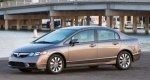 Honda Civic Hybrid is a good alternative for those who want a traditional looking sedan that seats 5. This front-wheel drive compact saves fuel at 42 mpg. At 4.4 annual tons of CO2e, this hybrid emits actually emits less greenhouse gases than its CNG cousin.
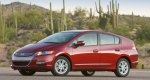 Honda Insight is a sporty four-door hatchback with an Ecological Drive Assist System. Although the Insight looks like the Prius, it is a bit smaller, lighter, and often $2,000 less than the Prius. The Insight will deliver 41 mpg combined, with annual emissions of about 4.5 tons of CO2e. Read about our 2010 Honda Insight Test Drive.
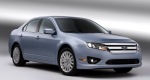 This roomy 5-seater delivers 39 mpg and 4.7 tons of CO2e per year. The Fusion Hybrid and its first cousin the Mercury Milan Hybrid may travel up to 47 miles per hour in pure electric mode. The Advanced Intake Variable Cam Timing allows for more seamlessly transition between gas and electric modes, making for a smooth and quiet ride. The Mercury Milan Hybrid offers the same drive system and body, with upscale interior. Read about Clean Fleet Report’s Fusion Hybrid test drive.
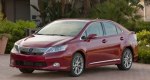 Lexus HS 250h is a stylish compact 4-seat sedan that delivers 35 mpg and 5.3 tons of CO2e per year. The Lexus brand lets your friends know that are using less petroleum by choice; you can afford a bit of luxury.
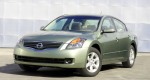 continuously variable transmission technology. The EPA rating is 5.4 tons of CO2e for the EPA annual driving cycle and a combined 34 mpg.
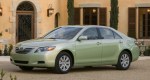 Toyota Camry Hybrid delivers good mileage for a midsize with an automatic transmission. The EPA rating is 5.4 tons of CO2e for the EPA annual driving cycle and a combined 34 mpg.
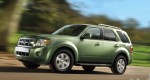 combined 32 mpg and emissions of 5.7 tons of CO2e – double the mileage and half the emissions of many SUVs. The mileage is an impressive 29 mpg for the 4-wheel drive versions of this SUV. With a common drive system and chassis, the Mercury Mariner Hybrid delivers the same carbon footprint and mileage.
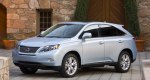 Lexus RX 450h with more acceleration and room than the others, costs more, starting at over $42,000. For a powerful SUV, it still conserves with 30 mpg and 6.1 tons of CO2e. Haul 5 people and lots of stuff without sacrificing quality and styling in the RX450h. The all wheel drive version has slightly better mileage than the Ford Escape Hybrid 4WD.
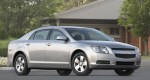 but you will go farther on a tank of gas. This mild hybrid gets 29 miles per gallon, with 6.3 tons of CO2e per year emissions.


